Just A Bit Outside
2025 outlooks and junk food

Ahh, ‘tis the season for 2025 financial market forecasts and outlooks. Many of them are actually quite useful, but not for the reasons that make TV headlines.
The CNBC headlines you’ll see are a slew of year-end price targets for the S&P 500 from the likes of Morgan Stanley, Wells Fargo, Goldman, Deutsche Bank, and many more.
Think of those year-end price targets like junk food. They taste good in the moment, but there isn’t a ton of nutritional value in them. In the end, they were probably the wrong thing to consume.
Just look at these price targets from last year that Sam Ro compiled.
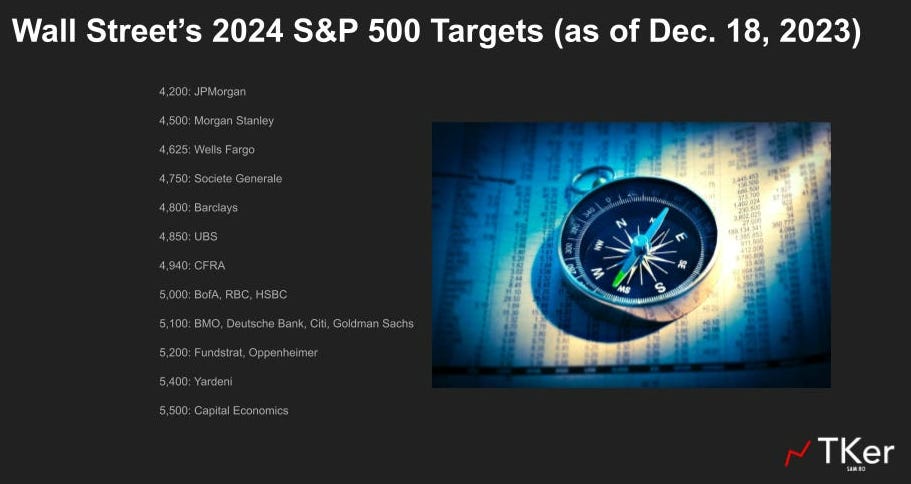
As I write this, the S&P 500 is 6,051. Safe to say the 2024 year end targets published last December were juuust a bit off.
And I’m not dunking on these targets, this stuff is hard. Most of us, myself included, did not have a ~30% gain on our bingo card this year for the stock market after the S&P 500 rallied ~24% in 2023.
After a downright nasty 2022, it’s safe to say you’ve been rewarded handsomely for powering through and staying invested.
Sam also compiled 2025 year-end price targets now that all of the big firms have published theirs.
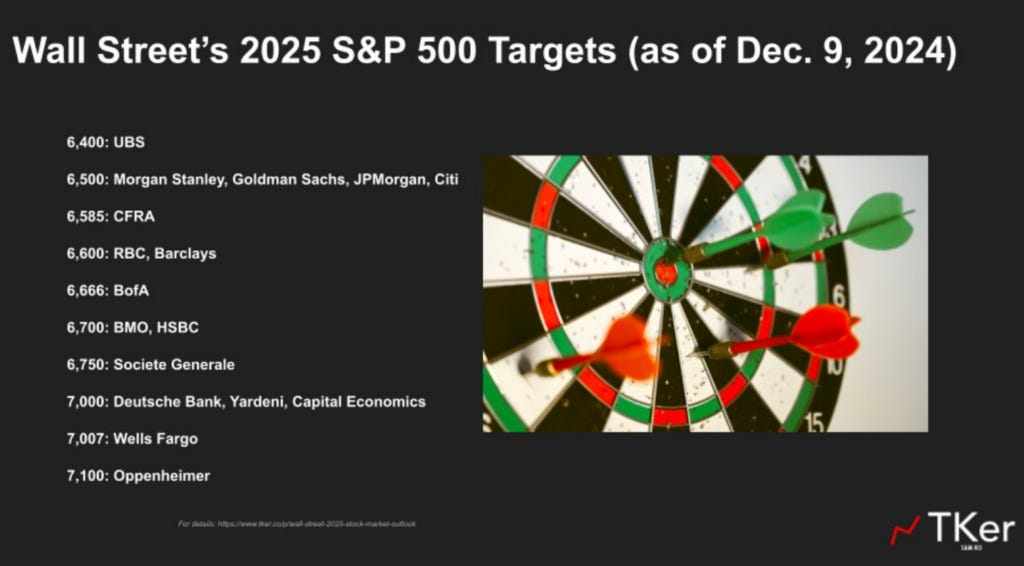
These firms all have some of the smartest strategists and analysts on the planet, and every single one is predicting another gain for the stock market ranging from about 7% to 17%.
There’s a few things I try to remind myself of when reading these:
While the year-end price target is the junk food, the rationale and research are the protein, fruits, and veggies. Just because the price targets may become useless by next year doesn’t mean that the research that went into them was useless. If you read any of these outlooks (here and here are a couple of my favorites thus far), you’ll learn a ton of what goes into the why behind the targets. Again, that’s the good stuff.
Most of the optimism stems from some combination of easing monetary policy, inflation remaining under control, the job market humming along at an acceptable rate, productivity gains leading to sustainable growth, and sentiment continuing its trend in the positive direction (i.e vibes on the rise).
Financial markets will always find a way to surprise you. Though the research in these outlooks is spectacular, let’s not gloss over the fact that each of their price targets were wrong last go-around.
A big part of that is because even if I gave you a crystal ball with the news headlines 3, 6, or 9 months from now, there’s no guarantee you could actually profit from it.
The perfect example is the stocks market ripping higher as we were all told to shelter in place and use Clorox wet wipes on our produce.
If the stock market can go higher when things look awful, the opposite is true too.
The building blocks are all 100% in place for another good year in the stock market, but as Daniel Kahneman said, "The correct lesson to learn from surprises: the world is surprising".
In other words, you never saw it coming because you weren’t supposed to see it coming…that’s the whole point.
We’re always one news headline away…tariff this, geopolitical crisis that…from the vibe shifting completely.
And last but not least, average returns in the stock market only exist on paper. The average stock market return is about ~7% annually adjusting for inflation.
Sounds smooth in theory, but in practice it will never feel that way. The last three years have been perfect examples: down nearly 20% in ‘22, up 24% in ‘23, and trending towards another huge up year in ‘24. It doesn’t take a rocket scientist to see these figures are nowhere near 7%.
It might have you wondering then why so many of the 2025 year-end price targets are hovering close to those “average” return numbers. These strategists are smart enough to know that average returns don’t happen often, but they’re also smart enough to not want to blow up their credibility over a blatantly wrong prediction.
Ben Carlson even ran the numbers on the average up and down years.
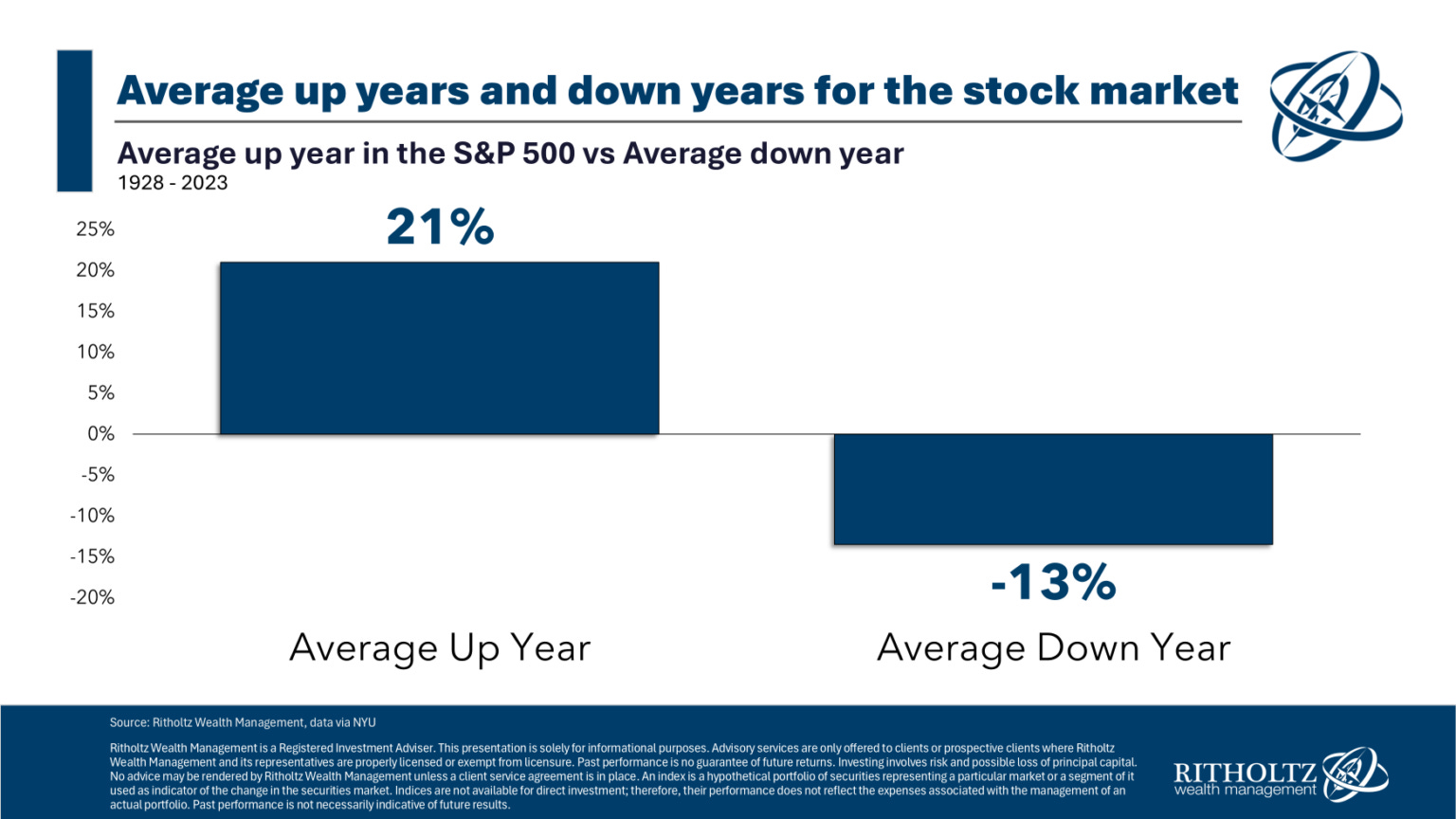
When the market is up, it tends to be up big. And when it’s down, we’re down pretty big. The stock market is really good at preying on our emotions, in both directions.
It’s why Adam Smith said: “If you don’t know who you are, the stock market is an expensive place to find out.”
So we all ought to know who we are, and stick to it.