Short Term Pessimist, Long Term Optimist
Why it's okay and normal to be both

It’s okay to admit you’re pessimistic in the short term. Heck, I am. And for those of you who know me well, you know I’m pretty optimistic. I’ll start with a few things I’m pessimistic about and conclude with why I’m still a long-term optimist - and why these two emotions can coexist just fine.
First, there is no stimulus package coming before the election. And it’s hard to imagine seeing a stimulus package anytime soon with the very real possibility of delayed election results capturing the attention of politicians - so it is unlikely that there will be a stimulus package anytime before February, in my estimation. I hope to be wrong, because the growth in jobs has been decelerating and people are hurting all over America. The longer a period of time someone spends unemployed, the harder it is for that person to regain employment. And regardless of your stance on fiscal policy, our once in a lifetime experiment of cutting checks to people that need it most who many lost their jobs through no fault of their own, worked incredibly well. What a concept that people who needed the money spent the money and the economic engine started to hum again.
Second, whether we like it or not, the virus is creeping back to scary high levels. Chicago halted indoor dining once again. Other cities probably aren’t far behind. France and Germany are locking down. We’re making headway in terms of how well doctors and nurses are treating patients with the virus, but it seems we’re not nearly out of the woods. It would really suck to lose steam on our progress. Hopefully we find a game plan that meets in the middle where economic activity doesn’t grind to a screeching halt again, but we can keep our vulnerable populations safe.
Last, this election will in all likelihood not be decided on election night. Regardless of which side you’re on, you can’t tell me being in limbo won’t bring out the worst in us. My gut tells me we could see peak divisiveness and finger pointing throughout the state of limbo we may be headed towards. I’m holding my breath on this one and hoping things stay calm, regardless of the outcome.
---
But is this really peak divisiveness? Perhaps, but I’m betting it’s most likely recency bias nudging us to think so. Morgan Housel writes:
History is “just one damn thing after another” said Arnold Toynbee. Dan Carlin’s book The End is Always Near highlights periods – from pandemics to nuclear war – where it felt like the world was coming to an end. They exist in every era, every continent, every culture. Bad news is the norm. Even during what we think were prosperous periods, like the 1950s and 1990s, there was a continuous chain of grief. Adjusted for population growth, more Americans lost their jobs during the 1958 recession than did in any single month during the Great Recession of 2008. The global financial system nearly fell apart in 1998, during the greatest prosperity boom we’ve ever seen. The world breaks about once every ten years, on average. For your country, state, town, or business, once every one to three years is probably more common.
So even though this feels like we’re in a pretty terrible place as a country, if you zoom out enough it's hopefully a reasonable statement to say this is just a normal blip.
Now let’s transition to what I’m optimistic about and why it’s okay to be pessimistic too - in the short term.
If you look closely, optimism and pessimism can coexist. If you look hard enough you’ll see them next to each other in virtually every successful company and successful career. They seem like opposites, but they work together to keep everything in balance.
While saving money is the pessimistic side of our emotions making sure we’ll make it through a rainstorm not if but when it hits, investing for the long term ought to be the optimist in us who believes in the overall long term progress of the world.
We’ve covered why being pessimistic in the short run is perfectly rational, but let me convince you of long term optimism. I believe there are more people that wake up each day looking to solve problems and create progress than those looking to create trouble. Not by much. But the odds tilt ever so slightly toward long-term progress amid frequent setback.
It’s been happening for thousands of years: millions of people solving one problem and moving on to the next, bit by bit, experiment by experiment. Since progress is cumulative (we don’t forget past innovations) but setbacks are temporary (we rebuild), the long-term odds tilt towards growth.
As long as more people try to get better than screw up, the long-term odds are in an economy’s favor. And that’s virtually always the case because the screw-ups – the declines, the recessions, and panics, the wars – fuel the problem-solving.
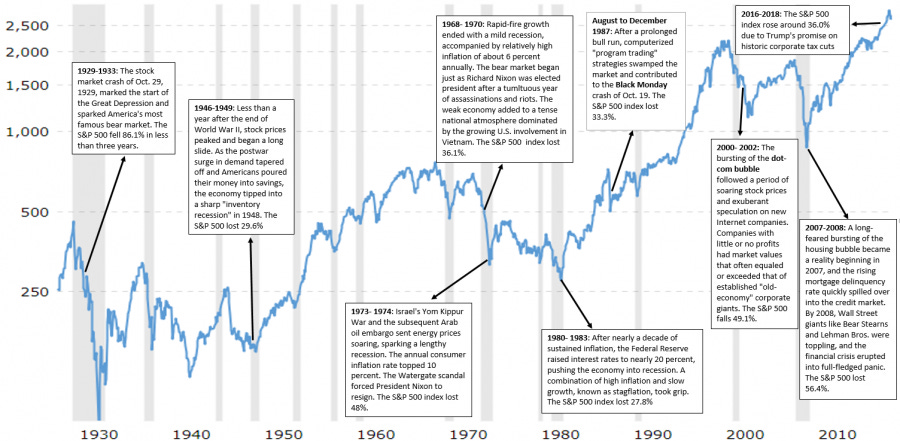
We’ve probably all seen a chart like the one at the bottom of this newsletter that shows the overall upward growth trend of the stock market. Amidst the greatest overall stock market on the planet, you can see we have plenty of terrifying moments along the way. Remember volatility is a fee you pay for growth, not a fine.
All good investing comes down to surviving an inevitable chain of short-term setbacks and disappointments in order to enjoy long-term progress and compounding. So if you’re pessimistic about the near future, you’re not a downer and it’s perfectly normal - but we all ought to be wired to be optimistic over the long run.